
The digital landscape has hit a point of no return. In 2026, the “death of the cookie” isn’t a future warning—it is our current reality. For years, marketers relied on third-party data to “follow” users across the web. Today, privacy regulations like GDPR and CCPA, combined with browser-level blocks, have made those old tactics obsolete.
At Seven Boats Academy, we believe this is the greatest opportunity in a decade. Why? Because a first-party data marketing strategy forces brands to be more human, more transparent, and ultimately, more profitable.
1. What is First-Party Data and Why Does it Matter Now?
First-party data is the information you collect directly from your audience. This includes email addresses, purchase history, website behaviors, and even preferences shared in WhatsApp communities.
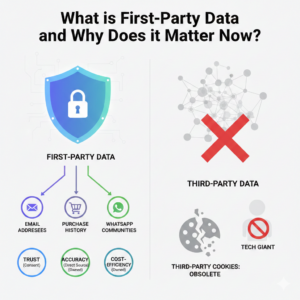
Unlike third-party data, which is often “rented” and inaccurate, first-party data is owned.
-
Trust: It is collected with explicit consent.
-
Accuracy: It comes directly from the source.
-
Cost-Efficiency: You don’t have to pay tech giants to “re-find” your own customers.
2. The Seven Boats Academy Approach: Collecting “Owned” Data
Transitioning to a cookieless world requires a shift in infrastructure. When you join a digital marketing course at Seven Boats Academy, we teach you the “Value Exchange” model. Users won’t give you their data for free; you must earn it.
Effective Collection Methods for 2026:
-
Interactive Quizzes & Tools: Use “Zero-party data” tools like ROI calculators or style finders where users share preferences to get a result.
-
Gated Premium Content: High-value whitepapers or exclusive webinars.
-
WhatsApp Community Building: Move beyond one-way broadcasts. Build communities where users opt-in for real-time value.
-
Progressive Profiling: Don’t ask for 10 details at once. Ask for a name today, an interest next week, and a location next month.
3. Turning Data into Personalization (The AI Connection)
Having a database is useless if you don’t “activate” it. In 2026, First-Party Data Marketing Strategy is powered by AI.
At Seven Boats, we show you how to feed your owned data into AI models to create Hyper-Personalization. Imagine an email that doesn’t just say “Hi [Name],” but actually suggests a product based on the specific blog post that user read three days ago. This level of relevance is what drives a 3.4x lift in ROAS (Return on Ad Spend) compared to generic interest-based targeting.
4. Overcoming the Challenges of a Cookieless Future
Many marketers are seeing “measurement gaps” because they can’t track users across sites anymore. To stay ahead, students must learn:
-
Server-Side Tagging: Moving tracking from the browser to the server to bypass ad-blockers.
-
Customer Data Platforms (CDP): Unifying data from your website, CRM, and social media into one single source of truth.
-
Identity Resolution: Recognizing that the person on your WhatsApp group is the same person who just abandoned a cart on your website.
5. How to Learn First-Party Data Strategy at Seven Boats Academy
If you are looking to enroll in a first-party data management course, you need more than just theory. Our Seven Boats Academy first-party data course is agency-styled. You won’t just read about cookies; you will build lead magnets, set up CRM automations, and run “Privacy-First” ad campaigns.
As the best institute for learning owned data marketing, we focus on the AACRO® model (Activation, Acquisition, Conversion, Retention, Optimization) to ensure your data strategy actually leads to revenue.
Conclusion: Your Data is Your Moat
In 2026, your “owned” audience is your most valuable business asset. Stop renting your growth from platforms and start owning it through a robust first-party data marketing strategy.
The “cookieless” world isn’t a barrier—it’s a filter that will separate the average marketers from the elite. Which one will you be?